Edge Reformed
Roles
Product Design, Research, Prototyping
DESIGN, PROTOTYPING, IDEATIONS, RESEARCH
Prototyping, Vizcom
Knife redesign project focusing on grip, balance, and kitchen safety based on user interviews.


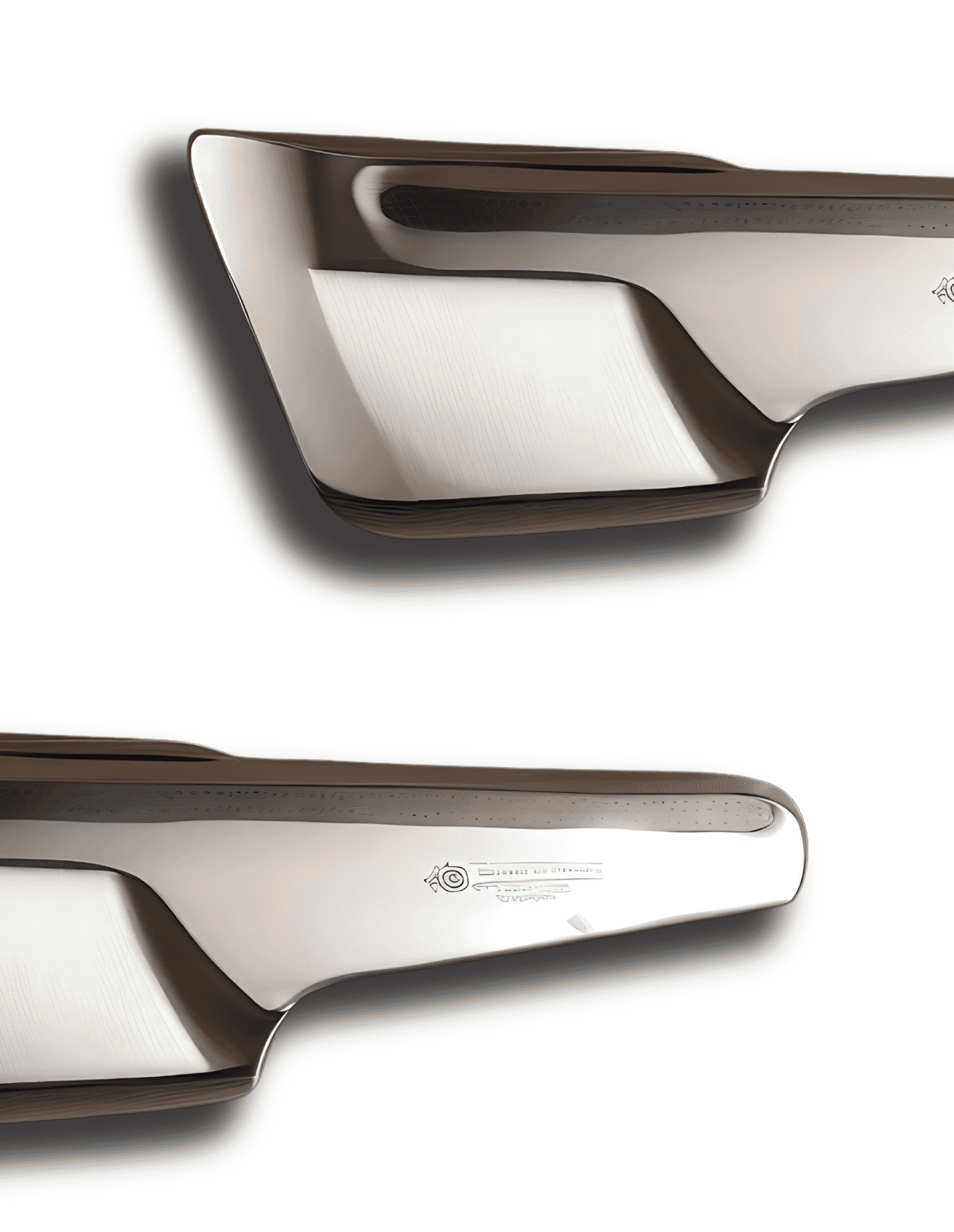
In most kitchens, cutting tools are overlooked as ergonomic instruments. They're treated as default utilities—sharpened occasionally, but rarely optimized for hand dynamics or safety. Edge Reformed addresses this gap through redesigning a kitchen knife around the user’s motion, grip pressure, and task flow.
Key Observations
Most users hold knives in ways that shift with task: slicing, chopping, mincing — grip changes, but most handles don’t adapt.
Prolonged use causes palm fatigue, especially in home kitchens without professional-grade tools.
Knife safety is often reactive (protective posture) instead of proactive (controlled ergonomics).
Blade orientation and tapering often prioritize sharpness over usability and control.
Design Focus
The project set out to create a blade-handle system optimized for hand feedback, finger orientation, and safe maneuverability. The redesign emphasizes alignment of blade weight with palm tension zones, enabling confident handling without strain.
Process Flow
1. Research & Observation
Kitchen ethnography, user interviews, and competitor benchmarking to analyze common hand movements, cutting flows, and safety failure points.
2. Grip Mapping & Form Sketching
Exploration of multiple hold styles (pinch, hammer, fingertip) to develop an adaptive form with a distinct rear flare and finger-notch contouring.
3. CAD Translation
The 3D model was built for a forged stainless-steel blade with composite handle infill, refining balance point and chamfer ergonomics.
4. Validation & Scenario Simulation
Foam-core mockups were tested in actual kitchen settings — slicing, chopping, dicing — to check grip fatigue, wrist stress, and edge visibility.
Result
Edge Reformed brings intuition back to kitchen tools. Its design blends hand-contoured form with cutting-task logic, providing users with greater control, reduced fatigue, and improved safety. It’s not just a knife—it’s an extension of the hand.